This year, Art Basel Hong Kong’s Encounters enters a new phase. Known for monumental installations and ambitious projects, the sector has been reimagined as a collective experiment. Led by Mami Kataoka, director of the Mori Art Museum in Tokyo, the initiative brings together a four-person team from across Asia: joining Kataoka are Hirokazu Tokuyama of the Mori; Isabella Tam of M+ Museum in Hong Kong; and Jakarta-based independent curator Alia Swastika, whose recent projects include the 16th Sharjah Biennial. Their shared question: Can an art-fair presentation function as a curated exhibition?
Encounters’ concept takes its structure from Asian philosophy – four aisles of the fair floor are organized into thematic constellations around the elements water, fire, earth, and ether. This anchors the installations within a shared discourse, testing how narrative, dialogue, and curatorial intent might operate amidst the heady buzz of the fair. Here, the four curators reflect on collaboration, process, and what they hope audiences will take away.
Kimberly Bradley: What has it been like to curate as a group, and specifically for a fair?
Mami Kataoka: When I was asked to curate the Encounters section, I felt that it is quite an intensive proposition – more than 10 big projects to be installed in just a couple of days. In terms of time and physical energy, I knew I needed some help. But also, I was curious about the possibility of curating a show within an art-fair framework. So, I invited curators who otherwise work in either institutions or biennials to work alongside me, because Encounters is full of larger works that are mostly collected by institutions or made for and exhibited at biennials.
Hirokazu Tokuyama: I’m used to this collaborative process because I work under the leadership of Mami at the Mori. We always co-curate exhibits, but what’s special here is that we all come from different institutions and regions. It was interesting to listen to the proposals from the other curators. I wasn’t familiar with most of the artists they presented. Curation is about intimate relationships with artists or artworks, so it was also a wonderful opportunity to share those relationships and experiences with my colleagues. It was a learning process and an open conversation.
Isabella Tam: We’re all based in Asia, but we have a lot of international connections through our work at our individual museums. This experience is different from my work at M+: For our shows there, we always think about a storyline and go very deep. For the context of the art fair, and also because I’m from Hong Kong, I have to think about the visitor experience even more than in a museum. Mami’s framework of the elements resonated with all of us. It’s a traditional Asian concept that’s loose enough to allow a wide range of artworks, but it also helps bring projects together, so viewers can discover narratives and dialogues between the different works.
Alia Swastika: The fair is a very different environment from my everyday practice: My curatorial work is mostly based on the idea of process itself – not really thinking about objects, but about relations. So Mami’s invitation to be involved in Encounters is both interesting and challenging, not only because of today’s economic situation but also with the major social and political issues around the world. It’s important to try to expand the impact or the scope of the conversations that can be generated from each project we proposed – to be able to respond to dynamic political situations.
Mami, you already work with Hirokazu Tokuyama, but had you worked with Isabella and Alia before?
MK: Yes, I worked with Alia in 2012 for the Gwangju Biennale. Isabella was one of the participants for the curatorial workshop that I co-conducted in Tokyo the same year. So, I’ve known them for a long time.
What do each of you consider your strengths and how do they fit together? Could you talk about process?
IT: My everyday practice looks at diasporic artists. At M+ we have research groups; each curator has a specific focus on a region or area. Mine include East Asia, and South and Southeast Asia. So, it was natural for me to propose artists I’ve been following over the past few years, as well as considering galleries in the region that I know. The fair’s audience is not just about Hong Kong – it’s international. So, I also considered how regional artists could resonate more broadly. When we first came together, Mami asked each of us to propose artists we were interested in. That initial step informed the selection process.
AS: There were two main approaches: First, we selected from the applications proposed by participating galleries. Second, we contacted galleries we’d previously worked with or artists that we were interested in bringing to Encounters, because each artist must come from a participating gallery. This created some limitations: I work a lot with Southeast Asian or Pacific artists, which could be seen as one of my strengths, and some of their galleries are not coming this year. Although Asia’s visibility is always strong, this shows there’s also a gap in resources within the region. But we opened up to the proposals sent by the galleries and created conversations between them. Reading the applications was interesting because we discovered many artists we didn’t know. There are also technical and display limitations in a fair context, so the process combined imagination with practical adjustments.
MK: I don’t know if I have a particular strength, but I’m interested in creating new significance through dialogue. There are so many good artists in different booths and with different modes of expression – by connecting them side by side, we created deeper or unexpected meanings. Through our discussions, I found things that I didn’t know.
What are your personal highlights?
MK: I’m excited about the structure of the whole. We have four aisles in the fair, and we allocated each aisle a topic – water, fire, earth, and ether. Each aisle has three artists. The conversations are interesting.
AS: I’m working with Gajah Gallery, who’s presenting the work of the Singaporean artist Suzann Victor. She’s showing City Lantern (2025), a collage of photographs on the shifting landscapes of cities, addressing the urban gentrification of many megacities in Asia. Victor displays this subtly, so the audience can have different experiences of it, but at the same time also relate to their own experiences of moving, or connect to the notions of mobility and migration. With Victor, we are trying to connect to the idea of land. Her work joins that of Hu Yinping, who works with potatoes in Potatoes Grow on Trees (2025-2026). Biological objects are a surprise for the audience; they also connect to soil and earth.
HT: For me, it’s Christine Sun Kim, who’s in the off-site venue. The piece, A String of Echo Traps (2022/2026) was shown in her retrospective at the Whitney Museum of American Art in New York last year. There, the piece was a tiny cube. This time she’s showing it in Pacific Place, a shopping mall in the heart of the city, so she has exploded this little cube to be three meters on each side [the project is supported by Swire Properties, the Official Partner of offsite Encounters]. It’s a gigantic video cube in the middle of a public space, along with a new floor drawing. There’s ambient sound coming from the video, and people can’t help but stop and engage with it. It pulls you in.
IT: When I thought about potential artists, I was conscious of interesting Hong Kong locals. Luckily, we got a proposal for Kongkee, who is famous for his cyberpunk aesthetic, which he combines with references to Chinese mythology. Hong Kong was once famous for its neon signs, and he incorporates that history into his work, too. His project reflects on technology, branding, and mythology in a contemporary way. Through the collaboration, I’ve also learned about artists I was less familiar with before, like Nobuya Hoki, an interesting painter, and Geraldine Javier, whose work I had only seen once before in the Philippines. Her installation is going to be immersive and very spectacular.
When did the group come together for the first time?
HT: Late August last year.
MK: I was asked much earlier, so I was already in discussions with Art Basel in the first half of last year about how to change the structure of Encounters. This new format is a bit of an experiment!
It seems like a dream team of trusted colleagues. What would you want visitors to take away?
AS: In an art fair, everything happens very fast. You move from one booth to another. The audience might not get the message or narrative right away, but we’ll try to give visitors the possibility to embrace the start of a visual memory that can lead to understanding various contexts in the future.
HT: In addition to the fast pace, the audience will also see the artwork in an art market context. It’s sometimes difficult to look at art there. But here, visitors can see where the market, the artists’ intentions, and the curatorial vision meet. It’s a rare opportunity. More than anything, I’m excited to witness the audience’s response in real time. That’s what I’m most curious about.
MK: I’d be happy if someone finds it curatorially interesting – if they see something more than individual artworks. My greater hope lies in the diversity of the works – some are more institutional, some are market-oriented, some are more for biennials. The gaps between them form what we call contemporary art. I want people to see the whole ecosystem. If this new Encounters triggers that, then I’ll be very pleased.
Art Basel Hong Kong takes place from March 27 to 29, 2026. Get your tickets here.
The work of Christine Sun Kim, on view at the Pacific Place Park Court mall in Hong Kong, is supported by Swire Properties, the Official Partner of offsite Encounters.
Kimberly Bradley is a critic, editor, and educator based in Berlin. She is a commissioning editor at Art Basel Stories.
Caption for header image: Isabella Tam, Mami Kataoka, Alia Swastika, and Hirokazu Tokuyama, curators of the Encounters sector of Art Basel Hong Kong 2026. Photograph by Ben Marans.
Recommended:
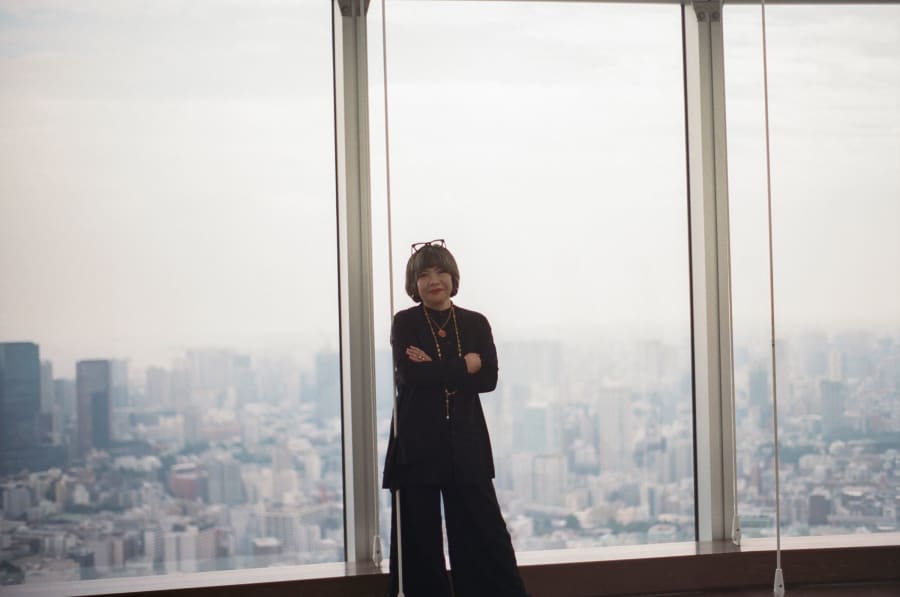
My Tokyo: curator Mami Kataoka
Ahead of Art Week Tokyo, explore the city's cultural landscape with the Mori Art Museum's director and AWT Focus curator
Read
Conversations | How to Build a Biennial Together
Biennials are reimagining curating as an exercise of working together by inviting curators and artists to collaborate on developing exhibitions. How do these collaborations expand the artist-curator relationship in the process?
Watch
Conversations | What can art fairs do for curating?
Encounters unfolds across the fair’s two floors as a monumental response to the ‘five elements’, a cosmological framework widely found across Asia. In this panel, Kataoka and artists exhibiting in this year’s edition will discuss the challenges and opportunities of exhibition-making in non-institutional spaces – and the productive friction it can generate
Book your seat